Press

File: c:/ddc/Angel/BestIntentions/Press.html
Date: Sat Sep 15 08:23:52 2007
      Thu May 29 12:16:46 2008
      Mon Jan 11 20:04:48 2010
      Sun Oct 03 12:37:37 2010
      Fri Feb 03 14:16:07 2012
      Fri Sep 28 23:05:17 2012
(C) OntoOO/ Dennis de Champeaux
The "press" is an old word that refers to the device that was used to replicate their articles. A better word to characterize our topic is "media", but we stick to "press" because ... well because.
We want to deal with only a fragment of the contents dealt with by the press. Sports, science, entertainment, celebrity trivia, travel, art, etc. will be ignored. Instead we want to focus on just politics. At the same time we do not restrict ourselves to the traditional printed form but include what is being delivered over the radio, on TV and now over the Web.
Lippmann understood that journalism's role at the time was to act as a mediator or translator between the public and policymaking elites. The journalist became the middleman. When elites spoke, journalists listened and recorded the information, distilled it, and passed it on to the public for their consumption. His reasoning behind this was that the public was not in a position to deconstruct a growing and complex flurry of information present in modern society, and so an intermediary was needed to filter news for the masses. Lippman put it this way: The public is not smart enough to understand complicated, political issues. Furthermore, the public was too consumed with their daily lives to care about complex public policy. Therefore the public needed someone to interpret the decisions or concerns of the elite to make the information plain and simple. That was the role of journalists. Lippmann believed that the public would affect the decision making of the elite with their vote. In the meantime, the elite (i.e. politicians, policy makers, bureaucrats, scientists, etc.) would keep the business of power running. In Lippman's world, the journalist's role was to inform the public of what the elites were doing. It was also to act as a watchdog over the elites as the public had the final say with their votes. Effectively that kept the public at the bottom of the power chain, catching the flow of information that is handed down from experts/elites.This description does refer to voting and hence it assumes a democratic setting. Most of this quotation - ignoring the voting - is, however, compatible with the press functioning in a dictatorship.
Dewey, on the other hand, believed the public was not only capable of understanding the issues created or responded to by the elite, it was in the public forum that decisions should be made after discussion and debate. When issues were thoroughly vetted, then the best ideas would bubble to the surface. Dewey believed journalists not only had to inform the public, but should report on issues differently than simply passing on information. In Dewey's world, a journalist's role changed. Dewey believed that journalists should take in the information, then weigh the consequences of the policies being enacted by the elites on the public. Over time, his idea has been implemented in various degrees, and is more commonly known as "community journalism."Dewey's description definitely relies on the press operating in a democracy. Journalists light the fire and the public adds fuel to public debates. Better ideas are supposed to emerge in these debates that leads ultimately to better decision-making.This concept of Community Journalism is at the center of new developments in journalism. In this new paradigm, journalists are able to engage citizens and the experts/elites in the proposition and generation of content. It's important to note that while there is an assumption of equality, Dewey still celebrates expertise. Dewey believes the shared knowledge of many is far superior to a single individual's knowledge. Experts and scholars are welcome in Dewey's framework, but there is not the hierarchical structure present in Lippman's understanding of journalism and society. According to Dewey, conversation, debate, and dialogue lie at the heart of a democracy.
Lippmann's version is more attractive from the perspective of government and has the advantage that it facilitates quicker decision-making. The price is that the population can easier become dissatisfied with what comes down to them.
Dewey's version makes strong assumptions about the capability of the population to participate in, for example, tricky debates where unpleasant trade-offs are necessary.
When we ask the question how the press is doing in terms of these two descriptions, we better narrow down the topic to the national level because debates and participation at lower levels are potentially easier and less relevant for what we are after.
Asking this question appears way easier than providing a convincing, solid answer. There is plenty of material available to be analyzed - the daily stream that is being generated - but its impact is obscure. In addition, democratic nations have different versions of democracy, have different sizes, different cultural histories, and thus one can expect that the mediating role of the press on the discourses between a government and the population varies. Plus there is the temporal dimension with fluctuating international developments, which can cause a government having to act quickly versus being able to engage in extensive public debates.
Consequently, what follows cannot be more than a random selection of 'data-points' that come to mind from the preceding decades that we will use to draw some tentative conclusions.
Ousting Nixon is often portrayed as a success of the American democracy. In a sense it is, because there was no revolution and neither was there a military coup or the like. It was a 'smooth' transition in comparison with the upheavals in other nations. Still we like to raise the awkward question why Nixon was (re) elected? Is it conceivable to have a US democracy that would have prevented him to be elected? Could the press have done a better job to avoid these convulsions in the country? We can sharpen up the question about the performance of the press regarding elections. We witness that the election results are converging more and more towards 50-50 results. Is the country really that divided? Or is the electorate very confused about the differences between the parties. If so, is this caused by intrinsic characteristics of the US democracy? Or is the press failing to probe deeper? Or what is going here? The Democracy chapter will revisit these questions.
Vietnam
The US involvement in Vietnam (1955-1973 and beyond)
remains a deep scar, see [Vietnam]. It was not an isolated event but
was part of grand-scale geo-political maneuvers in the cold war
against communist regimes, which, ironically, collapsed internally
since 1990. The press played a major role in deviating from the party
line: it fueled an increasing opposition against the American
operations. The press was at that time certainly not in the role as
described by Lippman: explaining the public what the elite was up to.
Hence the government was embroiled in two conflicts: battling
communism in Vietnam and battling the American public, who was
increasingly disenchanted by the discrepancies of what the government
had promised and what was reported by the press (among which the My
Lai Massacre in which US forces went on a rampage). To this day there
are opinions that America had a chance for a better end game if the
press would not have 'poisoned' the public.
This episode must have caused caution (if not resentment) in all subsequent administrations. A result has been that the press has been severely curtailed in later military operations.
2nd Iraq conflict
While many (including the press) after four years still talked about
the "Iraq war", we believe that the war lasted only a
few days and that the US forces since then were 'only' a kind of
police force operating in a severely dysfunctional society. There is
a disturbing parallel with the situation in Vietnam. The US
government misrepresented (or lied) about the motivation to invade
Iraq (likely in order to establish a democracy as an example to the
region, and plausibly to control the oil reserves), messed up the
status quo and misjudged the pathologies (from the perspective of the
West) in the Iraq society. The press exploited the bungling of the
government, which faced yet again a critical, if not hostile,
population.
In short: there was again no healthy discourse mediated by the press between the government and the population in which "the best ideas would bubble to the surface".
The press has less access to 'raw' news sources. Everyone produces nicely polished press reports. Interviews are controlled. Unpleasant questions are ignored, deflected, or reformulated to emphasize a pre-cooked position. Nixon still tried to find the culprits of leaks. The administrations after him (and the governments of other nations as well) have simply clammed up. Corporations also have public relations departments, which are equipped with a spokesperson that shields the corporation from direct access by the press.
Political reporting beyond regurgitating voting results, who said what, the occasional scandal, etc. is difficult, expensive and has a limited audience. The printed press, traditionally under pressure from radio and television, is now under assault by free info on the web and by free newspapers. Consumer advertisement revenues are shrinking due to websites like CraigsList.org on which one can advertise for free $10 bikes, $1M homes and everything in between. Reporting and commenting on international developments is the first to be cut back. National political topics are the next endangered item.
Political reporting on television is also getting more problematic. The attention span of the viewers is shrinking. Fixed speed media like radio and television are actually inadequate for difficult topics including politics. A presentation is too slow, thus boring, or too fast, thus incomprehensible. Reading allows to speed up when content is easy or familiar, or to slow down and mull things over when it is complex, dense, or idiotic.
The collapse of the NYC Twin Towers led to an access restriction of policy documents by the Bush administration. William Safire said in 2005 September: "The fundamental right of Americans, through our free press, to penetrate and criticize the workings of our government is under attack as never before."
We miss those articles these days, which appears to be caused by self-censorship. Overpopulation, declining IQ-scores, 6% of US GDP devoted to medical administrative overhead, unmonitored public education performance (5% of GDP), over dependency of the world on fossil fuel, legal tobacco use that kills millions versus illegal marijuana that kills no one, the medical establishment silent for decades about overpopulation and tobacco use while having high lethal error rates (for which they are not even sorry), etc., etc., are topics that are avoided.
Food prices have been rising steadily, which produces riots in poor nations. A radio program focusing on Afghanistan interviews a father and adds price increase statistics to illustrate the plight of this person. It is not mentioned that the average woman in Afghanistan has 6.58 children and that the 0-14 years cohort is 44.6% of the population. The press reported, of course, about the food riots in Haiti, but somehow omitted again the female fertility rate of 4.79 and the 0-14 years cohort of 41.8%. These omissions make sense because we do provide help to poor nations without conditions about family planning. Or it is the other way around, because these factoids have always been omitted, we do not attach conditions to help out starving nations, thereby increasing the problem.
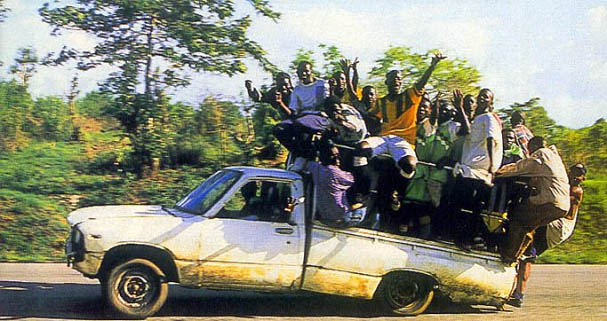
Reporting of natural disasters follows a standard pattern. An initial report of dozens of victims is followed by victims in the hundreds, thousands or many more. After a few days miraculous survivors are always trotted out. A bizarre incident, dutifully reported, involved a man dug out after several days and just walking away. The cause of severe flooding and mudslides wiping out whole villages is just heavy rains. Earthquakes do not need causes, they are just there. Famines are due to droughts. The ultimate cause of heavy loss of life - population living in too dangerous areas due to overpopulation - is never mentioned.
Politicians have often maneuvered themselves in parochial, left-right motivated deadlock positions. The press is supposed to transcend those paralysis situations and castigate the whole bunch. Instead they have equipped themselves also with left-right blinders.
Consider Al Gore's "An Inconvenient Truth" [Gore]. The reader is softly introduced with pleasant pictures and the human-interest material of his family to the brutally grim topic of global climate change, which is itself connected with exponential population growth, species extinction, resource exhaustion and many other calamities. A cartoon fragment illustrates the impact by depicting a drowning polar bear. Somehow the message of thousands of scientists has now been reduced on multiple websites that talk about how to save the polar bears.
Marketing texts provide another access path to who we are. Even prestigious Wall Street financial companies have send out offers for their services with an enticement of a "free gift".
What can we say more?
Many publications restrict themselves to the first category, which they buy from agencies and they may even give away their product by virtue of advertising revenues. Reporting that an oil rig exploded in the Gulf on 2010 April 10, that 11 people were killed, that they were drilling in a sea floor 1 mile deep, etc. is an example news item in this category. We can only wish them good luck with this business model.
Items in the second category are extended with evaluations/ judgments that are often in alignment with a particular political/ philosophical stance. A politically neutral article with the title "Onshore Oil Spill Response is Described as Chaotic" belongs certainly in this category by virtue of the valuation "chaotic". Although it is politically neutral, the phrasing of this title is evasive. Who used "chaotic" first? Why not simply "Onshore Oil Spill Response is Chaotic"?
Political stance of a news source can 'massage' the plain facts. The 2008-2010 Great Depression has been put more and more into the lap of the Wall street villains by simply ignoring all the other parties who overbuild the housing market, who (millions) bought houses while unqualified and whose unsound mortgages were accepted by Fanny & Freddie, semi-public companies, while Congress failed to intervene.
Press coverage of voting campaigns leaves much to be desired. The
root problem is the ambiguity of what one is voting for:
-- A party with its ideology and its perspective of the status quo and how to go
forward, or
-- A particular politician with its personality features and
of his/her historical record.
It would be great if the press would concentrate on the former.
Instead, the press too often dishes out private life trivia. The
press really looses it when a candidate starts mudslinging. Instead
of setting such a politician straight by urging to articulate relevant
visions about upcoming political choices, the press goes along and
gives ample attention to gory subsequent exchanges, thereby debasing,
muddling and short changing an essential component of our democracies.
Politicians promising new entitlements, tax reductions and similar enticements need to be grilled by the press to block 'childish' vote buying.
The public (some of the public perhaps) is currently under served with quality opinion pieces in which the author goes beyond parochial stances. Unpaid authors articulate sometimes positions that go far beyond what the paid editors can deliver. Here a letter to the Editor example about the above mentioned BP oil spill:
... Like so much commentary on the disaster, this focuses blame wholly on the oil company.The point of this example is not whether or not we agree with it. Instead, it illustrates the ability to transcend beyond the nitty-gritty of day-to-day hang ups and even suggests a long term way out, about which one certainly can quibble.
Undoubtedly BP is responsible, but so are all of us who drive cars, travel by plane or consume goods produced and shipped with oil. If we didn't use it, BP wouldn't drill for it. Until we recognize that demand for oil is as much the problem as supply, and start to change the way we live to reduce it, environmental destruction is inevitable.
We are all BP. (Martin Brown, NY 2010 June 12)
Here an example where a reporter took an unusual position. A 'pesky' bear, named Blondie, had to be killed. Humans were the root problem due to carelessness with garbage causing Blondie's ransacking behavior. The reporter quoted the following exchange on a subsequent Wildlife Committee meeting:
- "That bear broke into our home!" said one homeowner.This comes from a free paper "The Sheet" (2010 September). A commercial paper would likely have stayed away from interfering with local construction companies.
- "Then don't live in the mountains," replied the offended local.
A news source that routinely produces thoughtful perspectives that put events in large time frames could be something that is worth paying for so that self-censorship can be avoided.
[Hansen]Hansen, J., http://cleantechnica.com/2012/01/30/top-climate-scientist-on-need-for-clean-energy-action/
[Journalism] http://en.wikipedia.org/wiki/Journalism
[Vietnam] http://en.wikipedia.org/wiki/Vietnam_War
Mr. Sarkozy, in Lisbon for a two-day meeting of European Union leaders, was not in the mood to talk about his personal life on Friday. Asked by a reporter from Le Monde about his state of mind, he launched into a tiradeA first reaction could be that the Le Monde journalist is nicely put in his place. The second reaction could be why did the New York Times publish this? The third reaction is why the condescending "he launched into a tirade"? The next reaction could be: you folks please get lost ..."My state of mind is very simple: I was elected by the French people to solve their problems, not comment on my private life, and I would have thought a major newspaper like Le Monde would have a greater interest in Europe than in my private life," he said.
"Perhaps I should be flattered. If you think that the French people elected me for anything other than to work, work and work more -- for the rest, the French ask for no comment from me. It interests them much less than you, and they are right. And perhaps they have a greater sense of propriety and more discretion, sir."
Scientists need even more space to get their content accross. James Hansen uses 3300 words to make his points: about the press/media, about the politicians, about the befuddled public, about the fossil fuel industry and all of this in the context of climate change.
The reader is kindly invited to read his piece, which is a nice illustration of what has been covered in this chapter [Hansen]:
James Hansen, Director of the NASA Goddard Institute for Space Studies
The threat of human-made climate change and the urgency of reducing fossil fuel emissions have become increasingly clear to the scientific community during the past few years. Yet, at the same time, the public seems to have become less certain about the situation. Indeed, many people have begun to wonder whether the climate threat has been concocted or exaggerated.
Public doubt about the science is not an accident. People profiting from business-as-usual fossil fuel use are waging a campaign to discredit the science. Their campaign is effective because the profiteers have learned how to manipulate democracies for their advantage.
The scientific method requires objective analysis of all data, stating evidence pro and con, before reaching conclusions. This works well, indeed is necessary, for achieving success in science. But science is now pitted in public debate against the talk-show method, which consists of selective citation of anecdotal bits that support a predetermined position.
Why is the public presented results of the scientific method and the talk-show method as if they deserved equal respect? A few decades ago that did not happen. In 1981, when I wrote a then-controversial paper (http://pubs.giss.nasa.gov/abs/ha04600x.html) about the impact of CO2 on climate, the science writer Walter Sullivan contacted several of the top relevant scientific experts in the world for comments. He did not mislead the public by dredging up and highlighting contrarian opinion for the sake of a forced and unnatural 'balance'.
Today most media, even publicly-supported media, are pressured to balance every climate story with opinions of contrarians, climate change deniers, as if they had equal scientific credibility. Media are dependent on advertising revenue of the fossil fuel industry, and in some cases are owned by people with an interest in continuing business as usual. Fossil fuel profiteers can readily find a few percent of the scientific community to serve as mouthpieces - all scientists practice skepticism, and it is not hard to find some who are out of their area of expertise, who may enjoy being in the public eye, and who are limited in scientific insight and analytic ability.
Distinguished scientific bodies such as national science academies, using the scientific method, can readily separate charlatans and false interpretations from well-reasoned science. Yet it seems that our governments and the public are not making much use of their authoritative scientific bodies. Why is that?
I believe that the answer, and the difficulty in communicating science to the public, is related to the corrosive influence of money in politics and to increased corporate influence on the media.
It is a tragic and frustrating situation, because when all the dots in the climate-energy story are connected it becomes clear that a common-sense pathway exists that would solve energy needs, stimulate the economy, and protect the future of young people. As I discussed in "Storms of My Grandchildren," a gradually rising carbon fee should be collected from fossil fuel companies, with the money distributed uniformly to legal residents. This would stimulate the economy, making it more efficient by putting an honest price on fuels, incorporating their costs to society.
"Captains of industry" told me they would prefer such a course with knowledge of a steadily rising carbon price, which would stimulate innovations in efficiency and clean energies.
Despite the obstacles presented by the role of money in politics and by the huge advertising campaigns of the fossil fuel industry, the urgency of addressing the climate-energy issue demands that we do the best that we can to inform the public. One of the things we can do is try to expose how the public and our democracies are being manipulated for the benefit of those profiting from the public's fossil fuel addiction.
For that purpose I provided the witness statement below in support of an effort to reveal the name of the seed funder of the Global Warming Policy Foundation (GWPF) in the UK. GWPF is 'successful' in casting doubt on the reality and significance of human-made climate change.
The newsletters of Benny Peiser, Director of GWPF, can be quite
entertaining and sometimes include useful references. He pings the
impracticality and costliness of an energy approach that relies
excessively on renewable energies. But ultimately his purpose seems to
be to persuade the public that climate science is flawed. I don't know
if GWPF is supported by the fossil fuel industry, but it seems to me
that the public has the right to know. Ultimately, I hope and believe,
the public will be able to appreciate how our democracies are being
twisted by people with money for their own purposes. But that requires
freedom of information.
Jim Hansen
Some clarification of what this is about, the secret efforts of Lords,
the wealthy, the privileged, to dupe the public in our democracies
into supporting their continued and growing privileges, is provided by
this news article and press release:
http://www.brisbanetimes.com.au/environment/bid-to-out-the-money-behind-the-voice-against-climate-change-20120126-1qjfp.html
http://requestinitiative.org/2012/01/lord-lawson-should-name-funder-of-climate-sceptic-think-tank-judge-told/
STATEMENT
I, James Hansen of Kintnersville, Pennsylvania, USA, say as follows:
1. I am Director of the NASA Goddard Institute for Space Studies in New York City and Adjunct Professor of Earth Sciences at Columbia University's Earth Institute. I write here in my personal capacity, not representing these institutions. I was trained in physics and astronomy in the space science program of Dr. James Van Allen at the University of Iowa, receiving my Ph.D. in 1967. Since the mid-1970s my research has focused on Earth's climate and understanding the human impact on global climate. I am a member of the United States National Academy of Sciences, have testified about climate change to our Congress many times, and have met with officials of numerous nations concerning actions needed to stabilize climate and assure a bright future for young people.
2. I make this witness statement in support of Brendan Montague's appeal. The facts and matters set out in this statement are within my own knowledge unless otherwise stated, and I believe them to be true. Where I refer to information supplied by others, the source of the information is identified; facts and matters derived from other sources are true to the best of my knowledge and belief. References in this statement are to documents in the bundles of documents prepared for the Tribunal hearing.
The current situation regarding global climate change is described in a paper, The Case for Young People and Nature: A Path to a Healthy Prosperous Future, which I am preparing with the help of 17 international colleagues for submission to the Proceedings of the National Academy of Sciences, USA. The paper includes more than 100 scientific references supporting the discussion in my statement below. The abstract summarizing our paper is [posted at the top].
Science, as described in numerous authoritative reports, has revealed that humanity is now the dominant force driving changes of Earth's atmospheric composition and thus future climate. The principal climate forcing is carbon dioxide (CO2) from fossil fuel emissions, much of which will remain in the atmosphere for millennia. The climate system's inertia, which is mainly due to the ocean and the ice sheets on Greenland and Antarctica, causes climate to respond slowly, at least initially, but in a very long-lasting way to this human-made forcing.
Governments have recognized the need to limit emissions to avoid dangerous human-made climate change, as formalized in the Framework Convention on Climate Change. Despite this, the Kyoto Protocol, established in 1997 to reduce developed country emissions and slow emissions growth in developing countries, has been so ineffective that the rate of global emissions has since accelerated to almost 3%/year, compared to 1.5%/year in the preceding two decades.
There is a huge gap between rhetoric about reducing emissions and reality. Governments and businesses offer assurances that they are working to reduce emissions, but only a few nations have made substantial progress. Reality exposes massive efforts to expand fossil fuel extraction, including oil drilling to increasing ocean depths, into the Arctic, and onto environmentally fragile public lands; squeezing of oil from tar sands and tar shale; hydro-fracking to expand extraction of natural gas; and increased mining of coal via mechanized longwall mining and mountain-top removal.
Governments not only allow this activity, but use public funds to subsidize fossil fuels at a rate of about 500 billion US$ per year. Nor are fossil fuels required to pay their costs to society. Air and water pollution due to extraction and burning of fossil fuels kills more than 1,000,000 people per year and affects the health of billions of people. But the greatest costs to society are likely to be the impacts of climate change, which are already apparent and are expected to grow considerably.
Climate change is a moral issue of unprecedented scope, a matter of intergenerational injustice, as today's adults obtain benefits of fossil fuel use, while consequences are felt mainly by young people and future generations. In addition, developed countries are most responsible for emissions, but people in less developed countries and indigenous people across the world are likely to be burdened the most while being least able to adapt to a changing climate.
The tragedy of human-made climate change, should the rush to exploit all fossil fuels continue, is that transition to clean energies and energy efficiency is not only feasible but economically sensible. Assertions that phase-out of fossil fuels would be unacceptably costly can be traced to biased assumptions that do not account for the costs of fossil fuels to society or include the benefits of technology innovations that would emerge in response to an appropriate price on carbon emissions.
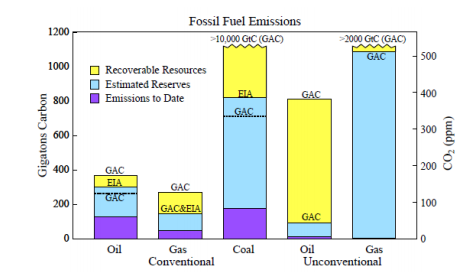
Fossil fuel emissions so far are a small fraction of known reserves and potentially recoverable resources, as shown in Figure 1. There are uncertainties in estimated reserves and resources, some of which may not be economically recoverable with current technologies and energy prices. But there is already more than enough fossil fuel reserve to transform the planet, and fossil fuel subsidies and technological advances will make more and more of the resources available.
Burning all fossil fuels would create a different planet than the one that humanity knows. The paleoclimate record and ongoing climate change make it clear that the climate system would be pushed beyond tipping points, setting in motion irreversible changes, including ice sheet disintegration with a continually adjusting shoreline, extermination of a substantial fraction of species on the planet, and increasingly devastating regional climate extremes.
Phase out of fossil fuel emissions is urgent. CO2 from fossil fuel use stays in the surface climate system for millennia. Failure to phase out emissions rapidly will leave young people and future generations with an enormous clean-up job. The task of extracting CO2 from the air is so great that success is uncertain at best, raising the likelihood of a spiral into climate catastrophes and efforts to 'geo-engineer' restoration of planetary energy balance.
Most proposed schemes to artificially restore Earth's energy balance aim to reduce solar heating, e.g., by maintaining a haze of stratospheric particles that reflect sunlight to space. Such attempts to mask one pollutant with another pollutant almost inevitably would have unintended consequences. Moreover, schemes that do not remove CO2 would not avert ocean acidification. The pragmatic path is for the world to move expeditiously to carbon-free energies and increased energy efficiency, leaving most remaining fossil fuels in the ground.
Transition to a post-fossil fuel world of clean energies will not occur as long as fossil fuels remain the cheapest energy in a system that does not incorporate the full cost of fossil fuels. Fossil fuels are cheap only because they are subsidized directly and indirectly, and because they do not pay their costs to society. Costs of air and water pollution caused by fossil fuel extraction and use, via impacts on human health, food production, and natural ecosystems, are borne by the public. Similarly, costs of climate change and ocean acidification will be borne by the public, especially by young people and future generations.
Thus the essential underlying policy, albeit not sufficient, is a price on carbon emissions that allows these costs to be internalized within the economics of energy use. The price should rise over decades such that people and businesses can efficiently adjust their lifestyles and investments to minimize costs. The right price for carbon and the best mechanism for carbon pricing are more matters of practicality than of economic theory. Economic analyses indicate that a carbon price fully incorporating environmental and climate damage, although uncertain, would be high. However, it is not necessary or desirable to suddenly increase fossil fuel prices. Instead the price should be ramped up gradually, with the money that is collected from the fossil fuel companies (at the first sale, at the domestic mine or port of entry) distributed on a uniform per capita basis to legal residents. More than 60 percent of the public would receive more in their monthly dividend, distributed electronically to their bank account or debit card, than they would pay in increased costs due to higher fossil fuel energy prices.
An economic analysis indicates that a tax beginning at a level of $15/tCO2 and rising $10/tCO2 each succeeding year would reduce emissions in the United States by 30% within 10 years. Such a reduction of carbon emissions is more than 10 times greater than the carbon content of tar sands oil that would be carried by the proposed Keystone XL pipeline (830,000 barrels/day).
Relative merits of a carbon tax versus cap-and-trade continue to be discussed. Cap-and-trade has had some, albeit limited, success in Europe, but failed in the arena of U.S. policy, as opponents won the rhetorical battle by describing it as a devious new tax. The merits of an alternative, a gradually rising fee on carbon emissions collected from fossil fuel companies with proceeds distributed to the public, have been summarized by DiPeso, Policy Director of Republicans for Environmental Protection, as: "Transparent. Market-based. Does not enlarge government. Leaves energy decisions to individual choices. Sounds like a conservative climate plan."
A rising carbon price is the sine qua non for fossil fuel phase out, but it is not sufficient. Other needs include investment in energy R&D, testing of new technologies such as low-loss smart electric grids, electrical vehicles interacting effectively with the power grid, energy storage for intermittent renewable energy, new nuclear power plant designs, and carbon capture and storage. Governments must support energy planning for housing and transportation, energy and carbon efficiency requirements for buildings, vehicles and other manufactured products, global monitoring systems, and climate mitigation and adaptation in undeveloped countries.
Rhetoric of political leaders, including phrases such as "a planet in peril", leaves the impression that they fully grasp the planetary crisis caused by rising atmospheric CO2. However, closer examination reveals that much of the rhetoric is aptly termed "greenwash" (J. Hansen, Storms of My Grandchildren, Bloomsbury, 2009, 304 pp.) as even nations considered to be among the "greenest" support expanded fossil fuel extraction including the most carbon-intensive fuels such as tar sands. The reality is that most governments, rather than taking actions to rapidly phase out fossil fuels, are allowing and using public funds to partially subsidize continued fossil fuel extraction, including expansion of oil drilling to increasing ocean depths, into the Arctic, and onto environmentally fragile public lands; squeezing of oil from tar sands and tar shale; hydro-fracking to expand extraction of natural gas; and increased mining of coal via mechanized longwall mining and mountain-top removal.
How is it possible that a specter of large human-driven climate change has unfolded virtually unimpeded, despite scientific understanding of likely consequences? Would not governments - presumably instituted for the protection of all citizens - have stepped in to safeguard the future of young people? A strong case can be made that the absence of effective leadership in most nations is related to the undue sway of special financial interests on government policies and effective public relations efforts by people who profit from the public's fossil fuel addiction and wish to perpetuate that dependence.
Such a situation, with the science clear enough to demand action but with public understanding of the situation, and thus political response, hampered by the enormous financial power of special interests, suggests the possibility of an important role for the judiciary system. Indeed, in some nations the judicial branch of government may be able to require the executive branch to present realistic plans to protect the rights of the young. Such a legal case for young people should demand plans for emission reductions that are consistent with what the science shows is required to stabilize climate.
Judicial recognition of the exigency and the rights of young people will help draw attention to the need for a rapid change of direction. However, fundamental change is unlikely without public support. Obtaining public support requires widespread recognition that a prompt orderly transition to the post fossil fuel world, via a gradually rising price on carbon emissions, makes overall sense and is economically beneficial.
The most basic matter, however, is not one of economics. It is a matter of morality - a matter of intergenerational justice. As with the earlier great moral issue of slavery, an injustice of one race of humans to another, so the injustice of one generation to another must stir the public's conscience to the point of action. Until there is a sustained and growing public involvement, it is unlikely that the needed fundamental change of direction can be achieved.
A broad public outcry may seem implausible given the enormous resources of the fossil fuel industry, which allows indoctrination of the public with the industry's perspective. The merits of coal, of oil from tar sands and the deep ocean, of gas from hydrofracking are repeatedly extolled, all of these supposedly to be acquired with utmost care of the environment. Potential climate concerns are addressed by discrediting climate science and scientists, including use of character assassination and every negative campaign trick that they have learned.
The fossil fuel kingpins who profit from the public's fossil fuel addiction, some of them multi-billionaires, are loosely knit, but with a well-understood common objective of maintaining the public's addiction. These kingpins have the resources to be well aware of the scientific knowledge concerning the consequences of continued exploitation of fossil fuels. However, they choose not only to ignore those facts, but to support activities intended to keep the public ill- informed. These kingpins are guilty of high crimes against humanity and nature. It is little consolation that the world will eventually convict them in the court of public opinion or even, unlikely as it is, that they may be forced to stand trial in the future before an international court of justice.
The fossil fuel kingpins are separated from the foot soldiers who serve as their public mouthpieces, separated by multiple layers of people, and even by corporations, which some courts have granted rights and protections of people.
The public has the right to know who is supporting the foot soldiers for business-as-usual and to learn about the web of support for the propaganda machine that serves to keep the public addicted to fossil fuels and destroys the future of their children.
This court cannot single-handedly cure the cancer that is afflicting democracies worldwide, the inappropriate power granted to money, to special financial interests. But by standing for the rights of the people, by exposing one link in the web of the oppressing fossil fuel propaganda machine, it just may start a process that allows the public to begin to realize what is at stake and where the public interest lies. Perhaps, if this process begins soon, there is still time to preserve a good future for young people and future generations.
I believe that the facts stated in this witness statement are true.
- James Hansen